The Blog

Avoiding Muscle Loss on GLP-1: What Actually Works (From Someone Who’s Done It)
Let’s chat about muscle loss on a GLP-1. Let me tell you something nobody warned me about when I started my GLP-1 journey: the real challenge isn’t losing weight, because these medications are incredible at that. It’s losing weight the right way, which involves keeping your muscle while the fat “melts off.”
I’ve lost 155 pounds on Mounjaro/Zepbound. I’m 5’5″ and have maintained for over a year, and I’m most proud of the fact that I’m stronger now than I was 155 pounds ago. How is that possible when so many people on GLP-1 medications end up looking “skinny fat” or lose their strength along with the weight?
As an Ivy League educated and Obesity Medicine Certified Registered Nurse, Certified Personal Trainer, and someone currently pursuing my PMHNP degree, I’ve combined my medical knowledge with hard won personal experience to crack the code on maintaining muscle on Ozempic, Wegovy, Mounjaro, and Zepbound.
If you’re worried about muscle loss on GLP-1s, or you’ve already noticed that you’re getting weaker, this post is for you. Let’s talk about what actually works, backed by science and proven by real results.
Why Muscle Loss Happens on GLP-1 Medications (And Why You Should Care)
First, let’s get clear on what’s happening in your body when you’re on semaglutide or tirzepatide.
The Science Behind Muscle Loss During Weight Loss
When you’re in a caloric deficit—which you absolutely are on GLP-1s thanks to that appetite suppression—your body needs energy. It gets that energy from three places:
- Fat stores (this is what we want)
- Muscle tissue (this is what we DON’T want)
- Glycogen (stored carbohydrates)
Here’s the problem: your body doesn’t preferentially burn fat. Without the right signals, it breaks down whatever’s easiest. Muscle is actually easier for your body to break down than fat, especially when you’re not using it.
Research shows that during rapid weight loss, people can lose up to 25-30% of their total weight loss from lean muscle mass if they don’t take protective measures. Let that sink in.
If you lose 100 pounds and 25-30 pounds of that is muscle, you’ve:
- Slowed your metabolism (muscle burns more calories than fat)
- Weakened your body
- Created loose, saggy skin (muscle provides structure)
- Set yourself up for regaining the weight
Why GLP-1s Make This Worse
Is muscle loss on a GLP-1 worse? GLP-1 medications are so effective at suppressing appetite that many people struggle to eat enough protein and overall calories. When you’re barely hungry and forcing yourself to eat feels like a chore, it’s easy to:
- Skip meals
- Choose easy, low protein foods
- Not prioritize nutrition
- Drastically under eat
I’ve seen people in online communities eating 600-800 calories a day on these meds, thinking “faster weight loss is better.” It’s heartbreaking because they’re literally wasting away, both fat AND muscle.
The Two Non Negotiables for Maintaining Muscle on GLP-1
After losing 155 pounds while building strength, I can tell you there are exactly TWO things that matter:
Everything else is secondary. You cannot maintain muscle without these two pillars. Period.
Let me break down exactly how to do each one.
Pillar #1: Protein – How Much, When, and What Kind
The Magic Number: 0.8-1.0 Grams Per Pound of Goal Body Weight
I know I talked about this in other posts, but it bears repeating because it’s THAT important; muscle loss on a GLP-1 is no joke.
For me at 125 pounds, I aim for 120-140 grams of protein daily. Some days I hit 110g, some days 150g. The key is averaging in that range.
Why this number? Because during weight loss, your protein needs are significantly higher than normal. You need enough to:
- Prevent muscle breakdown
- Support muscle protein synthesis
- Maintain your metabolic rate
- Keep your hair, skin, and nails healthy
- Support immune function
Protein Timing: Does It Matter?
Total daily protein matters way more than timing.
Your body CAN digest and use 70-100g+ of protein in a single meal. The “30g max” myth is outdated. However, there’s a small optimization benefit to spreading protein throughout the day.
- Muscle Protein Synthesis (MPS) peaks at around 25-40g of protein per meal
- But protein beyond that amount isn’t wasted, it’s instead used for other functions, prevents muscle breakdown, and supports overall protein turnover
- Spreading protein across 3-4 meals gives you more MPS “pulses” throughout the day
Therefore…
- Eating 120g protein in 2 meals works totally fine
- Eating 120g protein in 4 meals is about 5-10% more optimal
What matters most on GLP-1s:
Getting protein when you’re actually hungry enough to eat it!
Hitting your total daily protein target (this is 80% of the game)!
Spreading it reasonably (not eating 10g all day then 110g at dinner)!
My Protein Timing Strategy (What Actually Works for My Life)
Here’s the thing about protein timing: what matters most is finding a pattern that works for YOUR life and appetite on GLP-1s. I don’t eat breakfast. Never have, even before GLP-1s. Forcing myself to eat in the morning when I’m not hungry doesn’t serve me, so I don’t do it. Instead, I eat 2 meals + 2 snacks spread throughout the day, and I hit my 120-130g protein target consistently. Here’s what that looks like:
10:30am – Post-Workout Shake
- Orgain protein shake after the gym
- Gets me 20-30g protein when I’m actually ready to eat
1pm – Lunch (The Non-Negotiable)
- Salad EVERY. SINGLE. DAY. (I know, I’m that person)
- I rotate my protein: chorizo seitan, grilled chicken, or leftover protein from dinner
- Always includes beans, cheese, and my secret weapon: protein cottage cheese from Trader Joe’s as dressing (game changer)
- This meal typically gives me 35-45g protein
3-4pm – Snack
- Greek yogurt with berries
- Cheese sticks
- Cottage cheese
- Protein bar
- Whatever I’m craving that has protein (20-25g)
6-7pm – Dinner
- We cook homemade meals 5 nights a week, eat out 2x
- Every dinner is centered around a protein: mahi bowls, burger bowls, eggs with protein pancakes, you get the idea
- This gives me another 30-40g protein
8-9pm – Evening Snack (if needed)
- Usually Greek yogurt or cottage cheese
- Sometimes a protein bar if I’m short on my daily total
- 15-20g protein
Total: 120-135g protein
Notice that I’m not forcing myself to eat and just sticking to boring chicken and broccoli every day. I also don’t follow some perfect “bodybuilder meal plan,” nor do I stress if one meal has 50g of protein while another has only 20g. I instead eat foods I actually enjoy while hitting my daily protein target, spreading it reasonably throughout the day. I’ve made this plan sustainable for my real life as a working mom of three and grad student.
The key isn’t copying my exact meals but rather finding protein sources you like and a schedule that fits your appetite pattern on GLP-1s. Some people do better with breakfast. Some skip dinner. Some eat 6 small meals. There’s no single “right” way.
What Protein Sources I Actually Eat
When you have no appetite, you need protein sources that are:
- Dense (lots of protein per bite)
- Easy to eat (not super filling)
- Quick to prepare (you won’t cook when you don’t want to eat)
My staples:
- Eggs – Cheap, versatile, 7g each
- Greek yogurt – 20g per cup, goes down easy
- Cottage cheese – 25g per cup, I mix it into eggs
- Chicken breast – Meal prep on Sundays, 50g per 6oz
- Salmon – Healthy fats + 40g protein per 6oz
- Ground turkey – Lean, versatile, easy to batch cook
- Orgain protein shakes – 30g protein, tastes like chocolate milk
- Protein powder – Truvani is my go-to because of the ingredients, 20g per scoop
- Specific protein bars – I prefer Barebell and David Bars
What I avoid:
- Most protein bars (honestly the macros on so many are absolutely atrocious)
- Deli meats (too much sodium, not very satiating)
- Overly fatty meats (I need the protein, not the extra calories)
Pillar #2: Resistance Training – The Non-Negotiable
You cannot maintain muscle without using it. Protein gives your body the building blocks, but resistance training gives your body the SIGNAL to keep the muscle. When you lift weights or do resistance exercises, you’re telling your body: “Hey, I need this muscle. Don’t break it down for energy.” Without that signal, your body will absolutely catabolize (break down) your muscle, no matter how much protein you eat.
My Resistance Training Schedule
Here’s my current split:
Monday: Lower Body
- Legs and glutes
- 6-8 exercises, 4 sets each
- Followed by 15 minutes of stairclimber
Tuesday: Upper Body
- Back and shoulders
- 8 exercises, 4 sets each
- Followed by 15 minutes of stairclimber
Wednesday: Lower Body
- Legs and glutes
- 6-8 exercises, 4 sets each
- Followed by 15 minutes of stairclimber
Thursday: Upper Body
- Triceps/Biceps
- 8 exercises, 4 sets each
- Followed by 15 minutes of stairclimber
Friday: Full Body
- Depends on how I’m feeling
- Sometimes I take this as a rest day
Saturday: Spin Class
- 45 minutes, cardio day
- Not for muscle building, just for my mental health
Sunday: Pilates or Yoga
- Great for mobility!
Why This Schedule Works
Frequency: Hitting each muscle group 2x per week is the sweet spot for muscle maintenance and growth. Once per week maintains, but twice per week is better. Please keep in mind that the amount of exercises I do as well as my sets are longer since I really am hitting each upper body muscle group only once a week.
Intensity: I lift HEAVY. Not “toned with light weights” heavy. Actually challenging weights that I can only do 8-12 reps with, BUT with that said, my form is my biggest priority. There’s no vanity lifting; I’d rather go lower in weight and up my reps so that my form stays perfect.
Variety: Mixing lifting (traditional resistance) with Pilates and Yoga (slow, time under tension) hits muscles in different ways.
Recovery: I admit that I’m not the best at rest days, but I consider Pilates and Yoga to fall under the category of an active rest day. Sometimes I’ll take the full day off aside from walking. And then there are days, like Christmas, where I rot in bed when I want to. The key is sustainability, so you have to do what works for you.
If You’re New to Resistance Training
You don’t need to jump into my schedule just to prevent muscle loss on a GLP-1. Start here:
Week 1-4: 2-3 days per week
- Full body workouts
- Bodyweight or light weights
- Focus on form
Week 5-8: 3-4 days per week
- Start adding weight
- Upper/lower split or full body
- Progressive overload (gradually increase weight)
Week 9+: 4-5 days per week
- Established routine
- Challenging weights
- Consistent schedule
What Type of Exercise Actually Preserves Muscle?
Let me be clear: walking will not preserve your muscle. I love walking and walk my three dogs daily! However, walking is cardio, NOT resistance training.
Here’s what actually preserves muscle:
- Weight lifting (dumbbells, barbells, machines)
- Bodyweight exercises (push-ups, squats, pull-ups)
- Resistance bands
- Lagree/Pilates reformer
- CrossFit-style training
- F45, Orangetheory, Barry’s Bootcamp (if they include weights)
What won’t work for muscle preservation:
- Walking
- Running
- Cycling (cardio, not resistance)
- Swimming (unless you’re really pushing resistance)
- Yoga (great for flexibility, not muscle building)
The Progressive Overload Principle
This is the secret sauce: you must gradually increase the challenge.
Your muscles adapt to stress. If you’re squatting the same 10 pound dumbbells for 6 months, your body has no reason to keep that muscle.
Every 2-4 weeks, you should:
- Increase weight by 5-10%
- Add more reps
- Add more sets
- Decrease rest time
- Slow down tempo
I track my workouts in my Notes app. Simple format:
- Exercise name
- Weight used
- Reps completed
- How it felt
This lets me see progress and push myself appropriately.
The Science of Muscle Protein Synthesis (Known as MPS!)
Let me put on my science hat for a second and explain what’s actually happening at the cellular level.
How Your Body Builds (or Breaks Down) Muscle
Every moment of every day, your body is in one of two states:
Anabolic (building): Muscle Protein Synthesis > Muscle Protein Breakdown OR
Catabolic (breaking down): Muscle Protein Breakdown > Muscle Protein Synthesis
Your goal on GLP-1s is to spend more time anabolic than catabolic.
What triggers anabolism (muscle building):
- Eating protein (especially leucine, an amino acid)
- Resistance training
- Adequate sleep
- Hormones (testosterone, growth hormone, insulin)
What triggers catabolism (muscle breakdown):
- Caloric deficit (which you’re in on GLP-1s)
- Lack of protein
- Lack of resistance training
- High cortisol (stress)
- Poor sleep
Notice the caloric deficit is catabolic. You can’t change that, you need the deficit to lose weight. Therefore, you MUST compensate with the other factors.
The Leucine Threshold
Leucine is the amino acid that most powerfully triggers MPS. You need about 2-3 grams of leucine per meal to maximally stimulate MPS.
Foods high in leucine:
- Chicken breast: 2.5g per 4 oz
- Eggs: 0.5g per egg (you need 5-6 eggs)
- Greek yogurt: 2g per cup
- Whey protein: 2-3g per scoop
This is another reason why I space my protein intake throughout the day, so that I’m triggering MPS multiple times instead of just once or twice.
Common Mistakes That Cause Muscle Loss on GLP-1s
I see these mistakes constantly in online communities, and they break my heart:
Mistake #1: “The Scale Is Moving, So I Must Be Doing Great”
The scale doesn’t tell you what you’re losing. You could be losing muscle and thinking you’re crushing it.
The fix: Track more than weight:
- Take measurements (waist, hips, arms, thighs)
- Take progress photos
- Track strength (can you lift more than last month?)
- Notice energy levels
I’ve had weeks where the scale didn’t move but I lost 2 inches on my waist and added 10 pounds to my squat. THAT’s progress!
Mistake #2: Doing Only Cardio
Cardio burns calories. That’s it. It doesn’t build muscle, and it definitely doesn’t preserve it during weight loss.
The fix: Make resistance training your priority. Do cardio for heart health and mental health, but not as your main exercise.
Mistake #3: Eating Too Little Overall
Yes, you need a deficit to lose weight, but too aggressive a deficit (under 1200 calories for most people) guarantees muscle loss.
The fix: Eat enough to support your activity. I eat 1800-2100 calories most days to support my training.
Mistake #4: Not Tracking Protein
“I think I get enough protein” usually means you’re getting half of what you need. Trust me on this.
The fix: Track for one week. Use MyFitnessPal or Cronometer. You’ll be shocked how low it actually is.
Mistake #5: Inconsistent Training
Working out when you “feel like it” won’t preserve muscle. Your body needs consistent stimulus.
The fix: Schedule workouts like doctor appointments. Non-negotiable.
What My Results Look Like (The Proof)
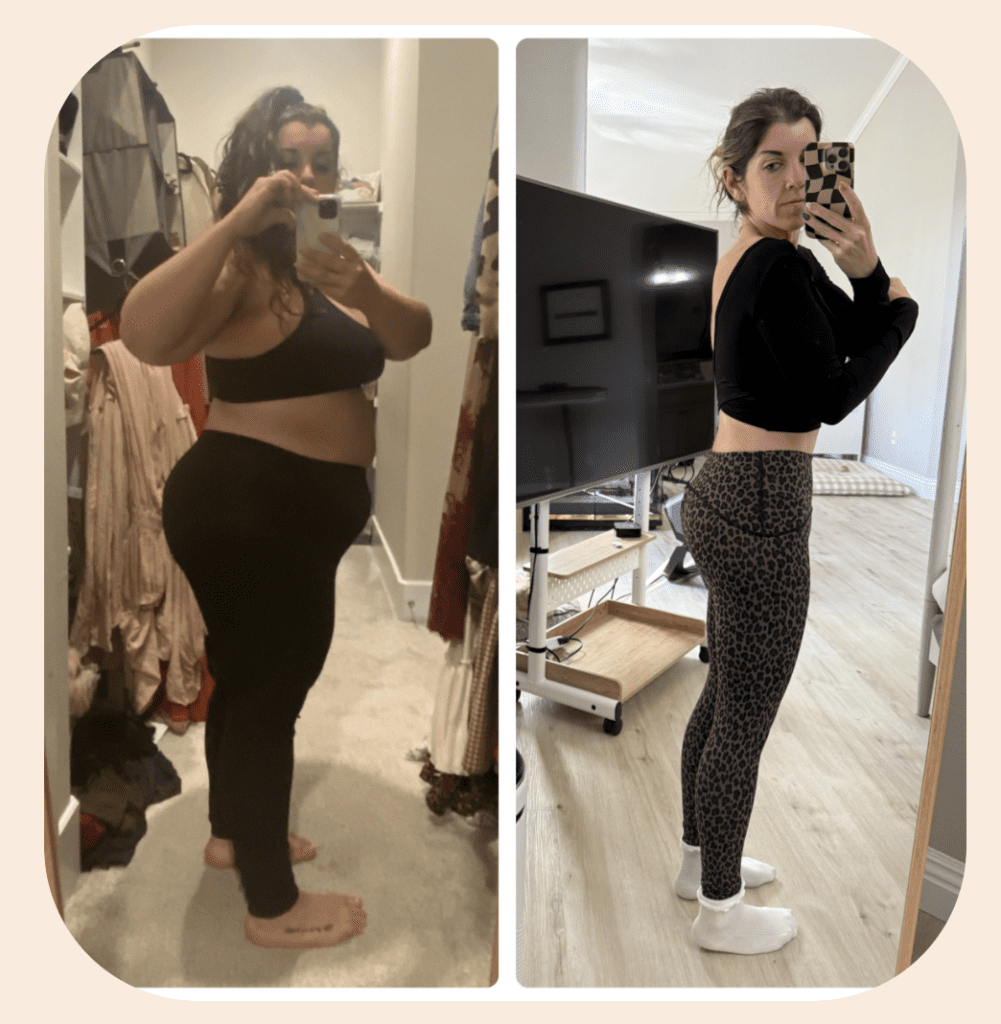
I don’t just talk about this stuff, I live it. Here’s what maintaining muscle on GLP-1s has done for me:
Body composition:
- Lost 155 pounds total
- Current body fat: 13% (DEXA scan confirmed—this is considered athletic/elite for women)
- Lost approximately 135-145 lbs of pure fat
- GAINED 10-15 lbs of muscle during my weight loss journey
- For context: 13% body fat puts me in the top tier for female athletes
Physical changes:
- Visible muscle definition in arms, shoulders, legs
- Flat stomach with visible ab lines
- Minimal loose skin (muscle fills it out)
- Fit into size 2 clothes, not just “smaller” sizes
Functional fitness:
- Can carry all my groceries in one trip
- Keep up with my three kids without being winded
- Have energy for long shifts
- Feel STRONG, not just “skinny”
Your Action Plan to Avoid Muscle Loss on GLP-1
Okay, enough science and theory. Here’s exactly what to do starting TODAY:
Week 1: Baseline
Day 1-2:
- Calculate your protein target (goal weight × 0.8-1.0)
- Take measurements and photos
- Download MyFitnessPal or Cronometer
Day 3-7:
- Track everything you eat for one week
- Find a gym or workout program (F45, Orangetheory, home program)
- Schedule 3 resistance training sessions for next week
Week 2-4: Build Habits
- Hit protein target 5-6 days per week
- Complete 3 resistance training sessions per week
- Track your workouts (weights used, reps)
- Weigh once per week, same day/time
Week 5-8: Progressive Overload
- Increase resistance training to 4 days per week
- Increase weights by 5-10% when exercises feel easy
- Continue hitting protein targets
- Take new photos and measurements
Week 9-12: Assess and Adjust
- Compare photos from Week 1
- Check strength progress (can you lift more?)
- Measure inches lost
- Adjust plan based on results
Supplements That Actually Help (And Don’t)
I’m not big on supplements, but there are a few that make sense:
Worth taking:
- Protein powder (whey or plant based) – Helps hit protein targets
- Creatine monohydrate (5g daily) – Supports muscle strength and size
- Vitamin D (if deficient) – Supports muscle function
- Multivitamin – Covers nutritional gaps when eating less
Not worth it:
- BCAAs (you get enough from protein)
- Fat burners (you’re already in a deficit)
- Testosterone boosters (don’t work)
- Most “muscle building” supplements
The Bottom Line on Muscle Loss and GLP-1 Medications
Here’s what I need you to understand:
GLP-1 medications are incredible tools for weight loss, but the medication doesn’t care if you lose fat or muscle. It simply suppresses your appetite and helps you eat less.
YOU are in charge of what you lose.
If you prioritize protein and resistance training, you’ll lose fat and keep (or even build) muscle. If you just eat whatever, skip workouts, and focus only on the scale, you’ll end up “skinny fat” and weak. Might sound harsh, but it’s true.
I chose strong and sustainable. My goal is to keep up with my grandkids, which starts NOW.
You can too.
Your Next Steps
- Calculate your protein target (goal weight × 0.8-1.0)
- Find a resistance training program (gym, F45, home workouts—just START)
- Track your protein for 3 days to see where you really are
- Schedule 3 workouts this week and treat them like doctor appointments
- Follow me on TikTok @JessicaRockowitz for all things behavioral health, psych, and obesity medicine.


Omg!! This whole article is spot on!! I’m the flip of you 🙁 I did exactly what you said DON’T do) I lost 30 by myself but it took 3 years, then I ask about a glp-1 and was given Zepbound! I then lost 90 lbs in a year. So HW 271 now CW 149. But I have lost muscle and collagen. Do I have severe wrinkles and a stomach apron no butt ( I thought I would never say that!) no boobs and I WAS wearing a DDD now an A or B so I wear stretchy ones only. I feel better as a lighter person but I did NOT do it right. I received NO instruction on how to properly use my glp-1. I am getting back on it ( I’ve been off for 3 months and I did maintain my weight) then the food noise and hunger came back and I decided to join a Zepbound support group on Facebook and I’m finding out more everyday things I should have done and will do differently. This article is the best! Thanks again for the info!!